ARTPOWER –
Designing tortoise, A Financial Platform for Artists, By Artists
Launching a new kind of fintech productivity app
2024-2025 | Instrument
Team makeup: Visual Designers, UX Strategists, Developers
This project involved: UX Strategy, IA, Product Design, Native App, Web
My Contribution: I came onto the project for Phase 1 and returned later for Phase 2. In Phase 1, I worked in tandem with the Lead UX Strategist to hone in on key features for a beta version in web app form.
In Phase 2, I led UX efforts to refine specific hero features including onboarding, dashboard, rates, and plans.
Across both phases, the teamwork was always divide and conquer between myself and fellow UX Strategist. We worked in pairs or small pods with Visual Designers and Developers.
Project Background
Who, What, and Why?
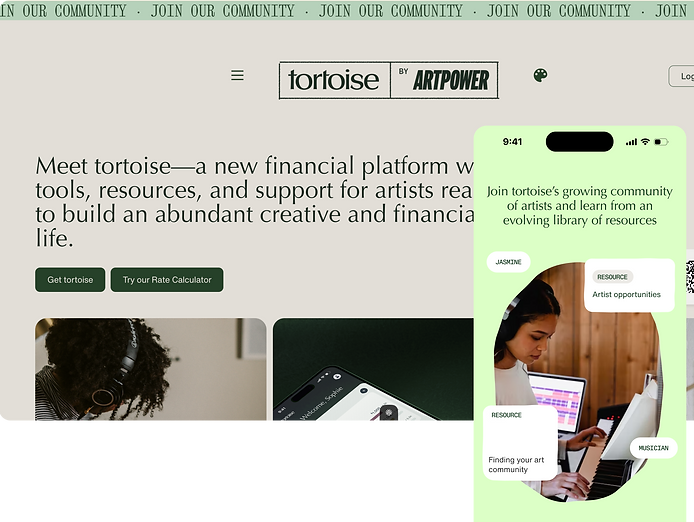
ARTPOWER consists of a team of artists, cultural strategists, and arts advocates founded in 2023 in Pittsburgh, PA, by janera solomon and her team of colleagues, to transform personal financial management tools for independent artists. From this goal came the tortoise app, a tool for artists, by artists.
Our team worked with ARTPOWER to bring tortoise to life and into the hands of real working artists. We collaborated with them in two phases: Phase 1 turned a myriad of concepts and ideas into a beta launch. Phase 2 focused on refining the product direction and key features based on the results of the beta and user testing.
The Opportunity
Empower working artists of all levels to build a sustainable financial future through their art practice.
User Research
Learning from beta
With the launch of the beta app in Phase 1, our team conducted a diary study to identify what was working and improvements for Phase 2. Three key features were flagged: onboarding, rates, and budgeting.
Concept iterations were tested in a follow-up qualitative study to:
-
Address pain points identified in the early 2025 beta test diary study.
-
Gather artist learnings to clarify and inform product strategy and design direction for the next iteration of those features.
Overall, the beta experience was a win, aka people loved the app and intention behind it.
Key Findings for Hero Features
Onboarding
TL;DR: not engaging and tonally missed the mark
Not inclusive enough to set the right tone for the app, or provide sufficient context
Rates
TL;DR: large desire for more customization
Made sense but needs to better align with artists’ mindsets and craft diversity
Budgets
TL;DR: needed heavy simplification
Needs clearer visuals and more targeted yet flexible financial functions
Our Approach
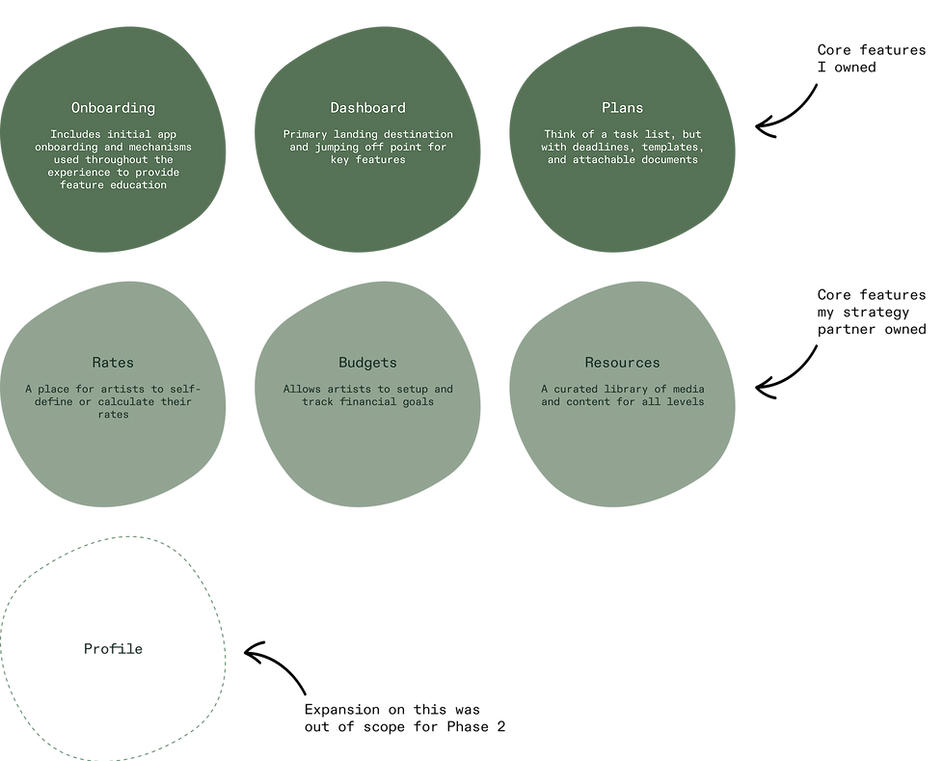
Given our timeline, we chose to divide and conquer: I was responsible for refining two of the core features along with onboarding based on the results of user research and freshly identified enhancements.
My fellow strategy partner and I worked in tight collaboration to bounce ideas, poke holes, provide feedback, and ensure a cohesive and holistic app experience. As a cross-functional team, we worked in pods: 1 Strategist, 1 Designer, 1-2 Devs.
Core Features
Strategy & Design
Enhancing & Redefining Onboarding
My approach consisted of:
-
Defining the purpose of onboarding in the context of the tortoise app to keep the experience focused (outlined below as key JTBD)
-
Addressing user needs based on the painpoints from research
Key JTBD:
Clarify the purpose and value of tortoise and its hero features to empower artists’ confidence in using tortoise by providing guidance and education
Onboarding Flow
Onboarding as a term was used to describe the moment of opening the app and what happens next, up until landing on the dashboard. It consists of three parts, outlined below.

Onboarding Part 1
Splash Screen
Being the first impression, it was important that the splash screen was hitting the mark tonally to properly express the brand and speak to a specific audience —artists, artistry, creatively expressive people.
A Note About The Splash Screen
Refinements to the splash screen was more of a brand and design exercise that involved my Visual Design partner working closely with a client stakeholder to get the look and feel, and animation just right. That work is not included in the story of this project because it’s not my story to tell.

Onboarding Part 2
App Intro & Account Setup
The tortoise app is addressing a gap in the market. Its newness and versatility warranted an introduction to give artists a clearer understanding of its capabilities and emphasize how tortoise could meet their needs.
App Introduction
With the research findings in mind, the problem space for me was to clarify the feature positioning and provide strategic recommendations for the visual design elements.
BEFORE
-
Visual elements were too ambiguous
-
Users are able to skip this experience
-
Hierarchy of information a bit chaotic
AFTER
-
Clearer visual elements without being too specific
-
Sharper copy and energetic animation
-
Text and visual pairing hierarchy improved for comprehension

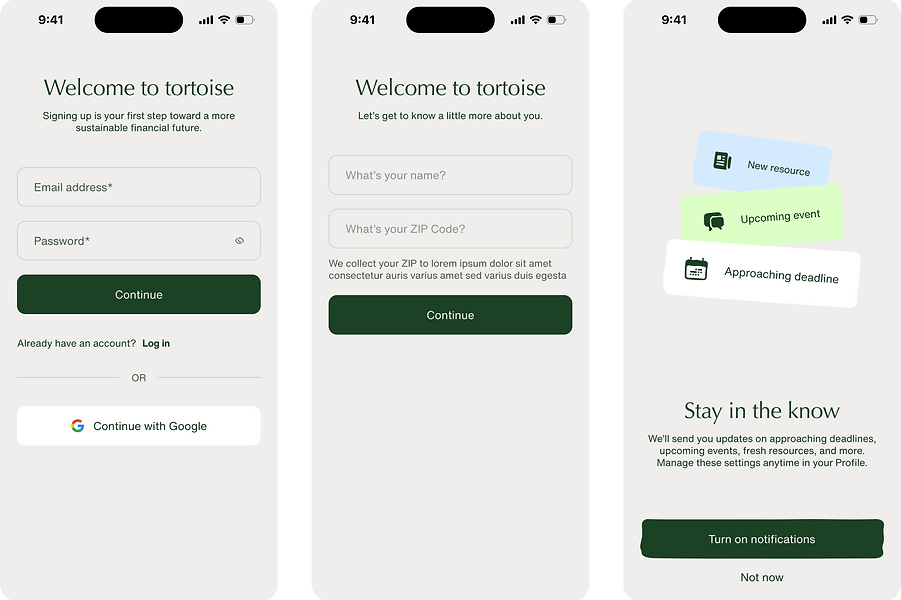
Account Setup Flow
The single screen evolved into a more stepped out flow to accommodate new requirements from the client and dev considerations around authentication and data storage.
BEFORE

AFTER
Onboarding Part 3
Self Selection
It was important for us and the client that people are quickly jumping into the app experience yet, given a certain amount of guidance without undermining a user’s autonomy and intelligence.
BEFORE
-
Visual elements mismatched to new evolving brand
-
Visual playfulness with card arrangements and lines caused confusion
AFTER
-
Clearer visual support for the three options
-
Simpler structure to improve user comprehension

Strategy & Design
Dashboard
The dashboard is the front door to tortoise welcoming artists in and enabling them to engage with features and track progress. It surfaces contextual modules and entry points to hero features like Budgeting, Rates, Plans, and Resources. It aims to adapt over time based on the artist's goals and usage patterns within tortoise.
Key JTBD:
-
Provide initial guidance as a first-time user
-
Help users see their progress over time by accessing upcoming deadlines
-
Keep user engaged by surfacing relevant content and guidance to additional features.
The Strategy of Flexible Dashboard
The dashboard responds to what artists care about—becoming a focused experience based on their selected motivation.
If they’re unsure, they can explore the broader set of hero features until a priority emerges based on their behavior.


"Quick Start" State
The dashboard design consists of modules, one for each hero feature. Rather than looking at nothing or an “empty state”, we wanted to address the client’s desire for people to quickly jump into using the app.
Each module starts in an actionable state (i.e. ‘Create X’, ‘Join Y’) that allows users to start taking their desired next step when they want, whether right away or later on.

Strategy & Design
Plan Management
Plans, the hero feature, is a family of tools that allows users to organize their ideas, goals, and projects into doable tasks with deadlines. The planning tools consist of Plans and Plan Examples.
-
Plans were an existing part of the beta experience and only needed small tweaks to the function and a visual design boost.
-
Plan Examples act as templates which removes some of the friction of ‘getting started’ with creating a plan by providing editable predefined tasks based on its category
-
A gallery was needed to house the Plan Examples so users can browse by category for a relevant Plan Example to use
Key JTBD:
Help users quickly and effectively create a structured plan by providing guided examples that facilitate goal achievement and community involvement

Outcomes
What Happened
The launch of tortoise was one of the biggest career highlights for me and members of the team, we had come to feel like proud and a tad overprotective parents across the entire timeline from Phase 1 in 2024 into 2025 with Phase 2.
And the client could celebrate a huge win of seeing what started as scrappy concepts being a live app readily available to artists across the US.